If the above search is not working visit the the below search bars.
Arrests.org is an online public records platform that offers access to arrest and booking information from law enforcement agencies throughout the United States. The website collects publicly available arrest data and organizes it into a centralized database, allowing users to locate records quickly and efficiently.
Users can search using multiple criteria, including a person’s name, state, city, or other available details. The information typically includes booking photographs, arrest dates, listed charges, and, in some cases, the location or agency responsible for the arrest. This structured presentation helps users review arrest records with clarity and ease.
Arrests.org is commonly used for background research, legal reference, and personal information checks. All records displayed on the platform are derived from publicly accessible sources and are provided in accordance with applicable public records laws. It is important to note that arrest records reflect reported incidents and do not necessarily indicate convictions or case outcomes.
What is Arrests.org?
Arrests.org is a centralized online database providing free access to public arrest records from thousands of law enforcement agencies nationwide. Unlike comprehensive background check services covering employment and credit history, the Arrests Org website specializes exclusively in arrest and booking records, including mugshots, charges, arrest dates, and booking information.
The platform operates under Freedom of Information Act (FOIA) principles, making government law enforcement records publicly accessible. Primary users include legal professionals for case research, employers for preliminary screening (with legal restrictions), property managers during tenant screening, journalists for investigative reporting, and individuals checking personal or acquaintance records.
How Arrests.org Works
Data Sources and Collection
Arrests Org aggregates data from county sheriff offices (primary source for booking logs), municipal police departments, state law enforcement agencies, and limited federal databases. The platform uses automated web scraping, API integrations where available, and occasional manual data entry to populate its database.
Update frequency varies dramatically by jurisdiction. Major metropolitan areas may show arrests within 24-48 hours on Arrest.org, while rural counties experience delays of weeks or have no coverage. The system standardizes formatting across different jurisdictions and uses name normalization to handle spelling variations and aliases.
How to Use Arrests.org to Find Arrest Records
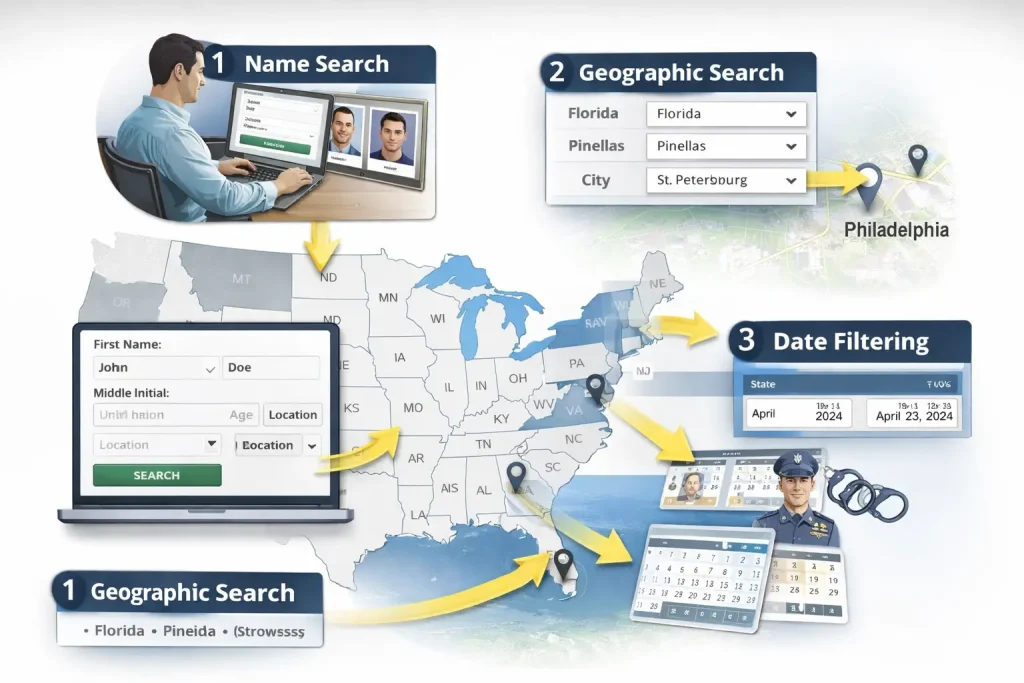
Search Methods
- Name Search: Enter first and last name. For common names, add middle initial, approximate age, or location filters to narrow results. The Arrests Org system matches exact and partial names.
- Geographic Search: Select state, then drill down to county or city level. This state-based approach on Arrest org significantly reduces false matches and provides localized results.
- Date Filtering: Specify timeframes to find recent arrests or historical records. Combine date ranges with geographic filters for precise targeting.
Search Optimization Tips
• Start broad, then narrow down with additional filters
• Try name variations: nicknames, maiden names, hyphenated names
• Search multiple time periods for comprehensive results
• Verify identity using age, location, and mugshot comparison
• Check adjacent jurisdictions if expected records don’t appear
Search Arrest Records by State on Arrests.org
The Arrests org platform organizes records geographically, enabling efficient state-level browsing. Each state page displays recent arrests, popular searches, and county-specific links. This hierarchical organization prevents nationwide result overload and speeds searches significantly.
Best-covered states include California, Florida, Texas, New York, and Illinois due to large populations and robust digital systems. States with restrictive public records laws may have limited Arrests Org representation. Always verify specific county coverage before assuming comprehensive state data.
Features of Arrests.org
- Name-Based Search: Comprehensive indexing allows searching across all jurisdictions simultaneously, eliminating the need to visit individual county websites.
- Geographic Filtering: Multi-level filters (state, county, city) enable precise location targeting, crucial for common names.
- Detailed Record Pages: Each arrest displays mugshots, complete charge listings with statutory codes, arrest date/time and location, booking facility and number, bond/bail amounts, and arresting agency information.
- Mobile Access: Responsive design enables smartphone and tablet searches, providing on-the-go access to the Arrests Org database.
- Premium Features (Subscription): Unlimited searches, advanced bulk querying, detailed report generation, priority support, and ad-free browsing. Free tier suffices for occasional users; professionals benefit from paid plans.
What Information is Available on Arrests.org?
- Mugshots: Booking photographs taken during processing, essential for visual identification when multiple individuals share similar names.
- Arrest Details: Date, time, and location of arrest; arresting agency; booking facility and booking number (critical for tracking cases).
- Charges: Initial charges filed (misdemeanor/felony classification), statutory codes, and charge descriptions. Note: These are preliminary charges that often change during legal proceedings.
- Personal Identifiers: Full legal name, date of birth, age at arrest, physical descriptors (height, weight, eye/hair color).
- Bond Information: Bail amount, bail type (cash/surety/property), whether posted. High amounts indicate serious charges or flight risk.
Critical Limitation
Arrests.org typically does NOT include case dispositions, conviction records, whether charges were dropped/reduced, sentencing information, or current custody status. Records show arrest moments, not legal outcomes. For complete background information, supplement with court records and professional background check services.
Benefits of Using Arrests.Org Website
- Centralized Access: Search thousands of jurisdictions from one platform instead of visiting dozens of individual sheriff websites, saving enormous time and effort.
- Free Basic Use: No-cost access to name searches, record viewing, and mugshots makes Arrests Org accessible for individuals and budget-conscious users.
- User-Friendly Interface: Intuitive design requires no technical expertise. Simple search options, clear results, mobile compatibility, and quick learning curve.
- Comprehensive Details: Unlike text-only databases, Arrests org provides extensive information including mugshots, complete charges, and booking data in organized, readable formats.
- Cost Efficiency: Even premium subscriptions cost less than obtaining official records from multiple counties individually. Single-county record requests often cost $10-50 each.
Anonymous Searching: Basic searches require no account creation or personal information disclosure, allowing discreet inquiries.
Who Uses Arrests.org Website?
- Legal Professionals: Attorneys, paralegals, and private investigators use Arrests Org for case preparation, witness verification, and background research. The speed and accessibility make it valuable for preliminary legal research.
- Employers and HR Departments: Used for preliminary screening before formal background checks. WARNING: Must comply with FCRA requirements. Using Arrest org alone for hiring decisions likely violates federal law and risks discrimination claims.
- Property Managers: Tenant screening supplement, though Fair Housing Act restrictions apply. Cannot use arrest-only information for automatic rejections.
- Journalists and Researchers: News verification, crime trend analysis, investigative reporting, and academic studies. The aggregated nature supports large-scale research projects.
- Individual Users: Personal record checks for accuracy, researching acquaintances (raises ethical questions), staying informed about local arrests, and verifying information. Bail bondsmen also use Arrests Org to locate potential clients.
Accuracy of Arrests Org Data
Common Accuracy Issues
- Outdated Information: The most prevalent problem. Records show initial arrests but rarely update with case outcomes (dismissals, acquittals, convictions). Accuracy degrades as cases progress without platform updates.
- Incomplete Coverage: Not all jurisdictions participate. Rural areas and small municipalities often have gaps. Negative results don’t prove no arrest history—only that records aren’t in this database.
- Data Entry Errors: Misspelled names, transposed dates, incorrect charges, or wrong identifiers occur occasionally during scraping or manual entry.
- Name Confusion: Common names return hundreds of results. Distinguishing the correct individual requires careful examination of age, location, and mugshots.
Verification Methods
• Cross-reference with county court databases using booking numbers from Arrests org
• Contact arresting agencies directly for current case status
• Check state court systems for disposition records
• Verify identity through multiple matching data points (age, location, appearance)
• Use professional background check services for critical decisions
Popular Searches on Arrests.Org
- Local Recent Arrests: Users frequently check arrests in their county/city from the past 24-48 hours, monitoring local law enforcement activity.
- Specific Name Searches: Individual lookups for employment screening, personal inquiries, or checking acquaintances generate millions of monthly queries.
- High-Profile Cases: Celebrity or newsworthy arrests drive traffic spikes as users seek mugshots and details.
- DUI/Drug Arrests: Consistently popular categories year-round, reflecting common enforcement priorities and user interest.
- Geographic Patterns: Highest search volumes in major metros (Los Angeles, New York, Houston, Chicago) and tourist destinations (Las Vegas, Miami, New Orleans). Florida, Texas, and California lead state-level searches.
Arrests.org Subscription and Pricing Options
- Free Tier: Basic searches, individual record viewing, mugshot access, state/county browsing. No account required for anonymous searching.
- Premium Subscriptions: Unlimited searches, advanced filters, bulk queries, downloadable reports, priority support, ad-free experience. Available as monthly or annual plans (annual offers better per-month value).
- Value Proposition: Individual county record requests cost $10-50 each. Premium Arrests Org subscriptions become cost-effective after just a few searches. More affordable than comprehensive background services, though less verified.
Privacy Concerns and Legal Considerations
Legal Restrictions on Arrests.org Use
Employment: Fair Credit Reporting Act (FCRA) requires employers to use Consumer Reporting Agencies, obtain consent, and provide adverse action notices. Simply using Arrests org for hiring violates FCRA. Ban-the-box laws in many jurisdictions restrict criminal history inquiries. EEOC warns that blanket arrest-based rejections may constitute illegal discrimination.
Housing: Fair Housing Act prohibits discrimination. HUD guidance warns against automatic policies based on Arrests Org data. Must consider individual circumstances.
Protected Records: Juvenile records should NOT appear (sealed by law). Expunged/sealed records should be removed. If found, request immediate deletion.
Ethical Use Guidelines
• Presume innocence—arrest doesn’t equal guilt
• Use only for legitimate purposes, not harassment or gossip
• Never share records publicly on social media
• Consider age and relevance before judging
• Verify thoroughly before taking action
How to Remove Records from Arrests Org
Removal Process
1. Gather Documentation: Court expungement orders, dismissal records, identification, proof of mistaken identity, or relevant state law citations.
2. Locate Removal Form: Find opt-out page on Arrests.org (typically in footer or FAQ section).
3. Submit Request: Provide full name, DOB, record URL, jurisdiction, and supporting documents. Save confirmation number.
4. Follow Up: Processing takes days to months. Follow up after 30-60 days if no response.
Alternative Strategies
• Legal expungement (strongest grounds for removal)
• Contact source agency for origin removal
• Hire attorney specializing in internet privacy
• Use reputation management to suppress search results
• File removal requests with search engines (Google, Bing)
Comparing Arrests.org with Other Platforms
| Platform | Best For | Cost | Key Limitation |
| Arrests.org | Quick preliminary searches, mugshot access, free research | Free basic, paid premium | No disposition data |
| County Sheriff Sites | Verifying data, current custody status | Usually free | Must search individually |
| State Court Databases | Finding case outcomes, conviction records | Free to low cost | Complex interface, no mugshots |
| Professional Background Checks | Employment, tenant screening, legal decisions | $20-100+ per report | Expensive for casual use |
Recommended Strategy: Use Arrests.org for quick preliminary searches, verify with county/state sources, and invest in professional services for high-stakes decisions (employment, legal proceedings).
Critical Understanding: Arrest vs. Conviction
This is the most important concept when using Arrests.org: ARREST DOES NOT EQUAL GUILT.
Arrest records document only that law enforcement detained someone on suspicion of criminal activity. Possible outcomes include charges dropped entirely, not guilty verdict, case dismissed by prosecution, plea to lesser charges, or conviction. Arrests.org shows only initial arrests, not outcomes.
To find what actually happened: Use booking numbers from Arrests.org to search county court databases, contact arresting agencies for case updates, check state court systems for dispositions, or obtain professional background checks including conviction records.
Using arrest records alone to judge character or trustworthiness is unfair and potentially illegal in employment/housing contexts. Many people have arrests for charges that were dismissed or resulted in acquittal.
Conclusion
Arrests.org provides valuable centralized access to public arrest records, offering convenience and cost savings. However, responsible use requires understanding limitations: incomplete disposition data, variable accuracy, jurisdictional gaps, and legal restrictions on use.
Best practices: Always verify critical information through official sources. Never use Arrests.org alone for employment or housing decisions. Presume innocence and recognize arrests don’t prove guilt. Consider ethical implications before sharing or using arrest information. Supplement with professional services for high-stakes decisions.
By combining Arrests.org’s convenience with verification, legal compliance, and ethical judgment, users can access public records responsibly while protecting both their interests and the rights of individuals in the database.
Frequently Asked Questions
Is Arrests.org free?
Yes for basic use. Name searches, viewing records, and mugshot access are free. Premium subscriptions ($20-50/month typically) unlock unlimited searches, advanced filters, and bulk queries.
How current is Arrests.org data?
Varies by jurisdiction. Major metros: 24-72 hours. Rural areas: weeks or no coverage. Check county sheriff sites directly for most current information.
Does arrest mean convicted?
No. Arrests.org shows only arrests, not outcomes. Many arrests result in dismissed charges or acquittals. Check court records for case dispositions.
Can employers use this for hiring?
Not alone. FCRA requires using Consumer Reporting Agencies, obtaining consent, and providing adverse action notices. Using Arrests.org as sole screening tool violates federal law.
How do I remove my record?
Submit removal request through Arrests.org opt-out form with supporting documents (expungement orders, dismissals). Legal expungement provides strongest grounds. May require attorney assistance.
Does it cover all states?
All 50 states included, but coverage depth varies. Best in California, Florida, Texas, New York, Illinois. Limited in rural counties and restrictive states.
Are juvenile records shown?
No. Juvenile records are sealed by law and should not appear. If found, request immediate removal as likely violation of privacy laws.
How far back do records go?
Varies by jurisdiction. Typically 10-20 years for digitized records. Some areas extend further; others show only recent arrests.
Is this admissible in court?
No. Considered hearsay without proper authentication. Obtain certified copies from arresting agencies or courts for legal proceedings.
What’s the difference from official background checks?
Professional checks include verified conviction records, dispositions, multi-jurisdictional searches, employment/education verification, FCRA compliance, and dispute processes. Arrests.org shows only unverified arrest records without legal compliance framework.